
This social media post I saw deserves a response.
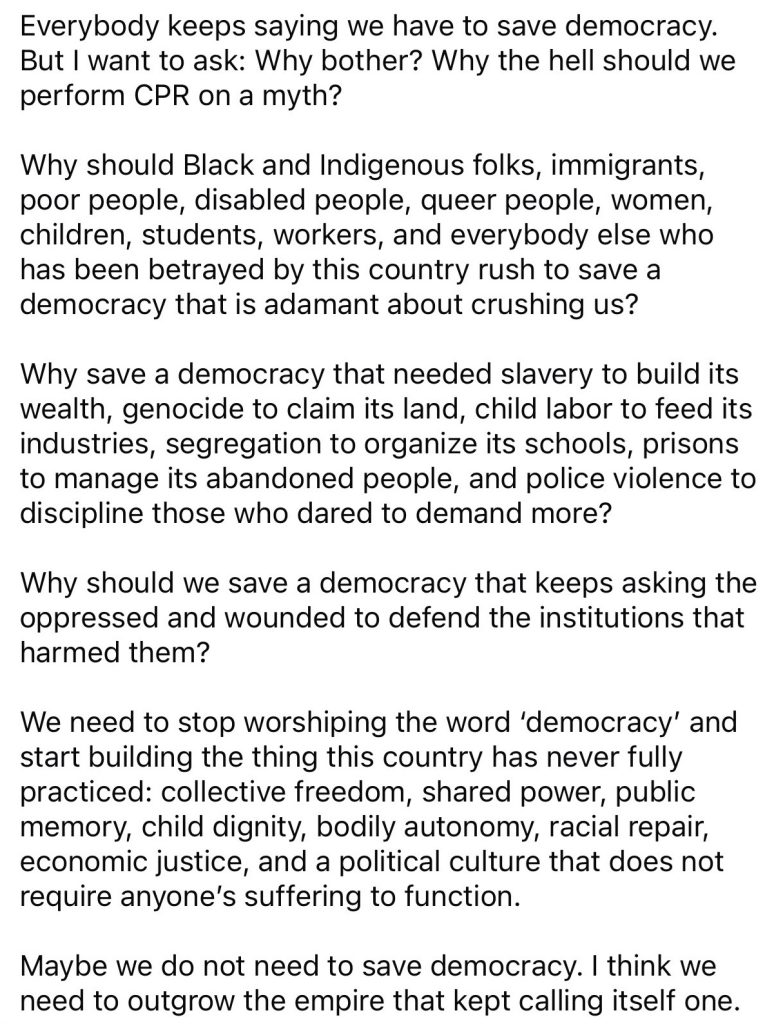
The pain in this post is real, and the betrayals are real. I don’t want to argue past that.
But I keep coming back to one question it doesn’t answer: replaced with what?
The 20th century ran that experiment at scale. The Soviet Union, Maoist China, and Cuba were explicitly anti-capitalist, anti-imperialist projects built on the same moral foundation: the system is rotten, the oppressed deserve better, start over. Cuba is often held up as the exception — a revolution that actually meant it. But the Afro-Cuban and LGBTQ communities Castro claimed to liberate faced persecution under his government, the party elite lived differently than the people, and equal outcomes turned out to mean equally shared scarcity for most. The people who suffered most when these revolutions went wrong were not the powerful — they were the poor, ethnic minorities, dissidents — the very people the revolutions claimed to liberate. Concentrating power to dismantle power is a trap that has closed on every generation that tried it.
Oppression didn’t begin with American democracy and isn’t unique to it. Slavery, genocide, subjugation of minorities predate democracy by millennia and have flourished under every form of government, including ones built explicitly to abolish hierarchy. The difference isn’t that democracy eliminates these forces — it’s that it gives the oppressed something to fight back with.
The civil rights movement didn’t overthrow the system. It worked through it — courts, legislation, protest, the vote. Those tools were imperfect and weaponized against the people using them. And yet: the Civil Rights Act passed, Brown v. Board passed, the Voting Rights Act passed. Slowly, painfully, with reversals — Reconstruction gave way to Jim Crow, and gains made in the 1960s have met fierce backlash in the 2020s. Maddening, but not unprecedented. The arc has bent.
The Framers knew the Constitution was an imperfect compromise — that’s why they built in the amendment process. A system designed to be improved, not worshiped. And it has been: thirteen amendments have expanded rights, not restricted them.
Is that process clogged right now? Yes — polarization, the filibuster, a Court that’s redefined money as speech. But that’s an argument for unclogging it: end the filibuster, add DC and Puerto Rico as states, restructure a Court that’s drifted from the people it answers to. A clogged process is a reason to clear it, not abandon it — and self-correction is something democracies can do to themselves that authoritarianism cannot.
Maybe the goal isn’t to outgrow democracy. It’s to outgrow the empire hiding inside it — without becoming one ourselves.
Defenders of revolutionary socialism often point to Cuba as proof that the model can work — a small nation that stood up to empire, eliminated illiteracy, and built a healthcare system despite decades of embargo. Those achievements are real, but… Read more